Rockledge Drive Residential Historic District: what's listed and why it survived
The Rockledge Drive Residential District was listed on the National Register on August 21, 1992. Roughly two miles of coquina-bluff residences from 1875 to 1949, built for Northern winter visitors. Here's what's in the district and how it dodged the post-war demolition wave.
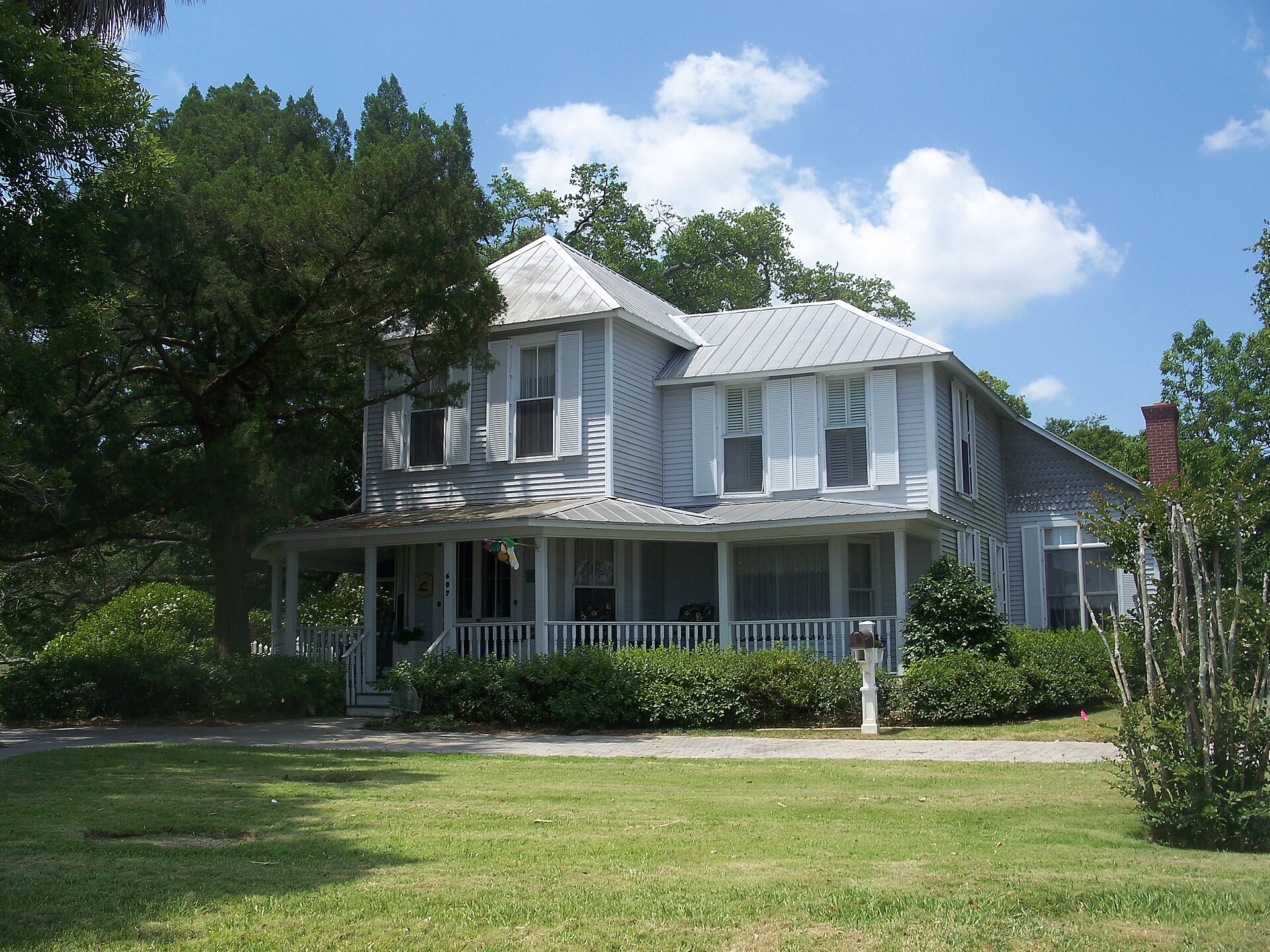
The Rockledge Drive Residential District was listed on the National Register of Historic Places on August 21, 1992 (NRHP reference number 92001045). The district covers 520 acres along Rockledge Drive (numbers 219 through 1361), Rockledge Avenue (numbers 15 through 23), and Orange Avenue (numbers 1 through 11), and contains 100 contributing historic buildings. The earliest contributing structures date to the mid-1870s; the period of significance spans 1875 to 1949 in three subperiods (1875-1899, 1900-1924, 1925-1949) with key reference years of 1880, 1887, and 1924. The district was listed as part of the Rockledge Multiple Property Submission and is one of the larger residential historic districts in Brevard County.
Why it survived
Three reasons: geographic isolation, owner-occupant continuity, and a 1990 listing that preceded most modern Rockledge development pressure.
Rockledge Drive runs along the river edge of the city, not the U.S. 1 commercial corridor. The Drive never had a commercial-strip phase; it stayed residential because the lots were narrow, deep, and oriented to the water rather than the road. Post-war commercial development concentrated on U.S. 1 and on Eyster Boulevard, west and north of the historic district. The Drive escaped the demolish-and-rebuild churn that hit, for example, Cocoa Village’s residential blocks in the 1950s and 1960s.
Most of the houses had long-tenure owners or stayed within extended families through the mid-20th century. The same families occupying the same houses for decades meant maintenance, not demolition.
The 1992 NRHP listing came at the right time. By the early 1990s Florida real estate pressure was again building (the post-recession recovery, the Viera planned community on the western edge of Rockledge that had broken ground August 4, 1989), but the listing established the district before any major redevelopment proposal was on the table.
What’s in the district
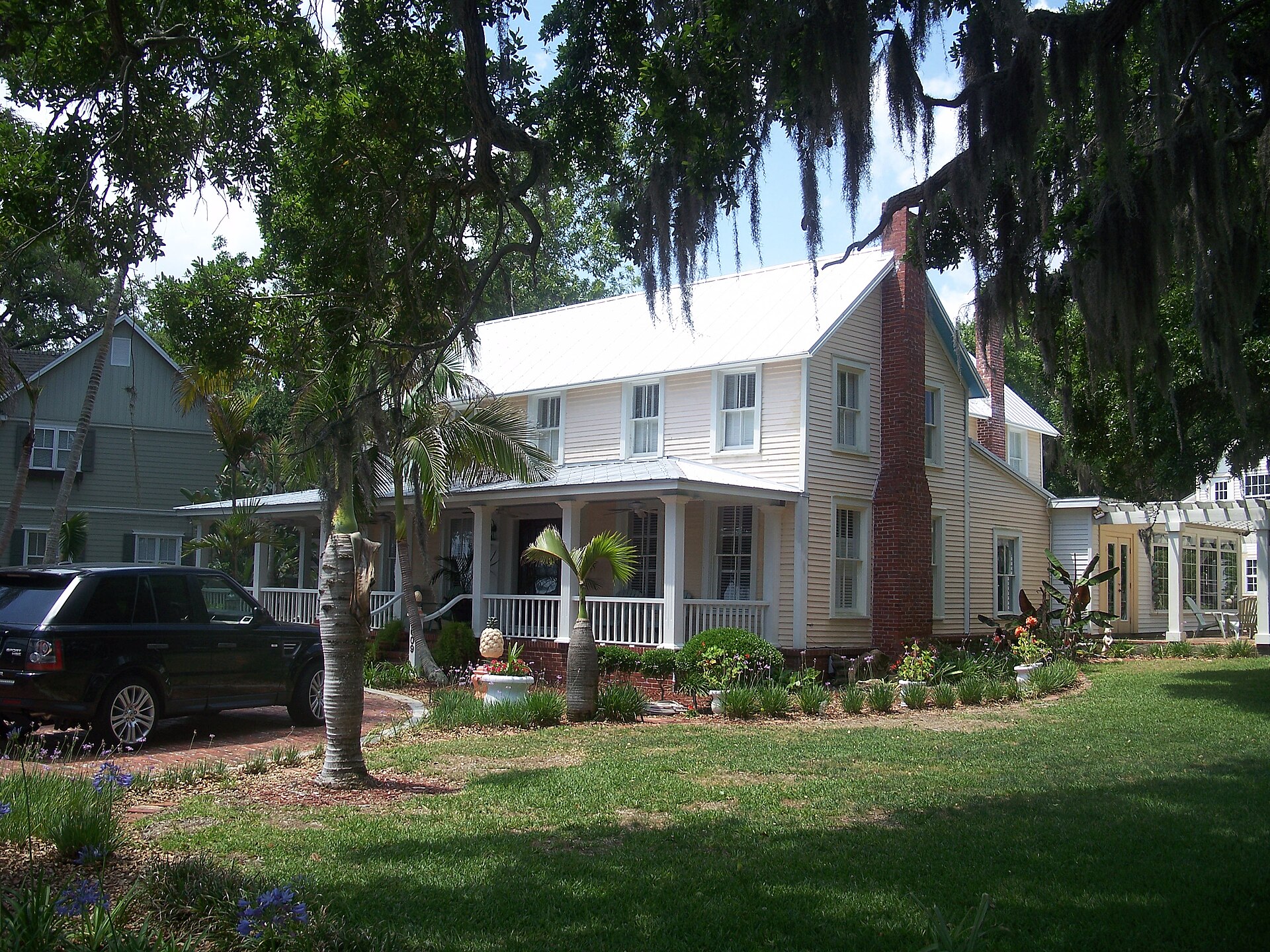
The district’s contributing structures span 1875 to 1949, with three formal subperiods of significance: 1875-1899, 1900-1924, and 1925-1949. The architectural mix includes:
- Frame Vernacular (the largest share): one- and two-story wood-frame houses with wide porches, gable or hip roofs, often with shed-roof additions. The 1880s and 1890s houses are typically in this style.
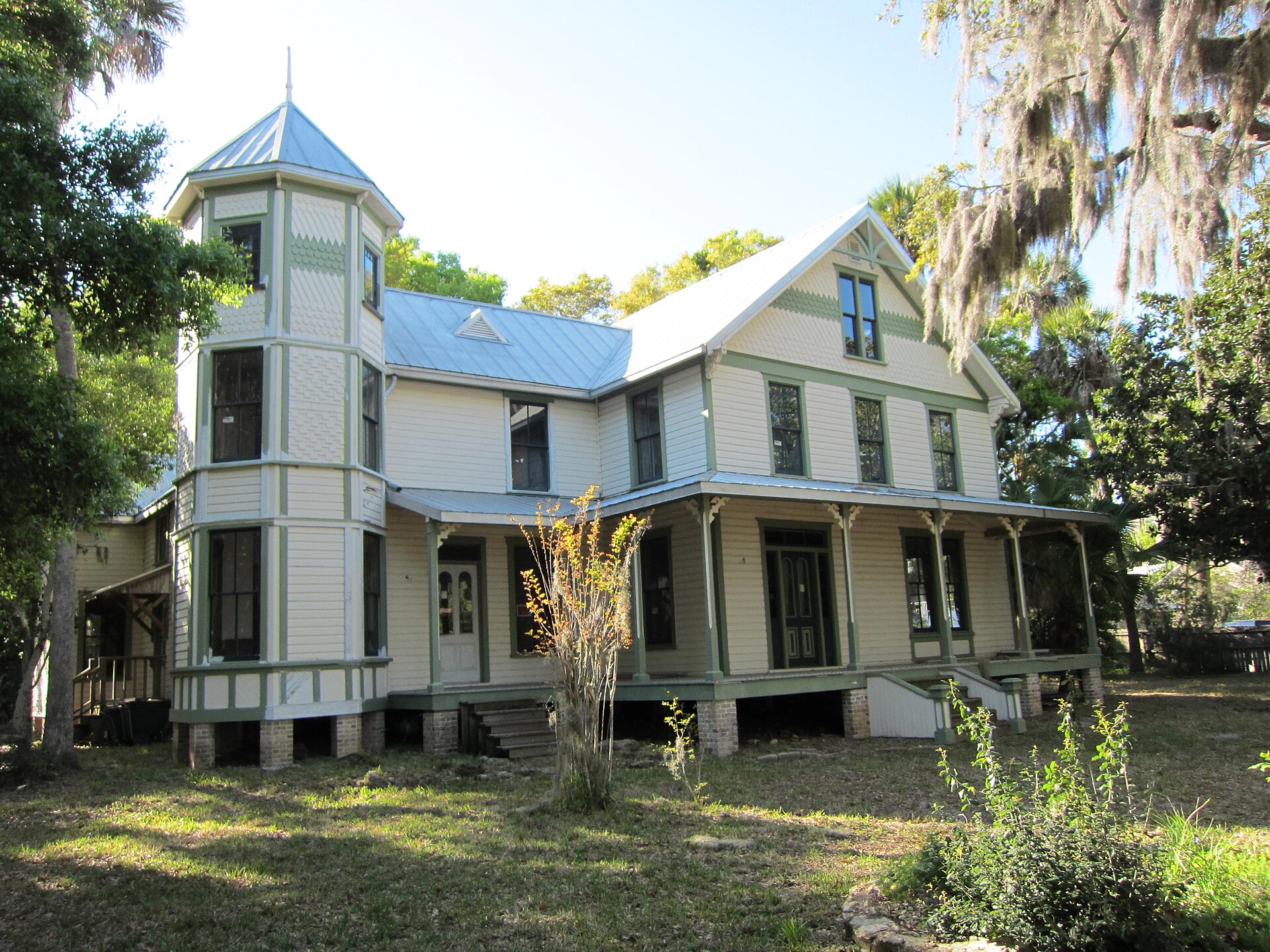
- Queen Anne: a smaller number of high-style Queen Anne residences from the 1890s and 1900s, with corner towers, asymmetrical massing, and ornamental shingle work.
- Frame Vernacular with Colonial Revival elements: late 1890s through 1910s, with classical porticos grafted onto the basic Frame Vernacular shape.
- Bungalow / Craftsman: 1910s and 1920s, smaller-scale houses with exposed rafter tails, low-pitched roofs, broad eaves.
- Mediterranean Revival: a small number from the 1920s land boom era, with stucco walls, tile roofs, and arched windows.
The NRHP nomination form lists each contributing building with construction date, builder where known, and architectural style. The original homeowners include names that recur in Rockledge history: Williams, Magruder, Whaley, Hardee, Travis. Many of the houses are named for their first owners (Magruder-Whaley House, H. S. Williams House) and retain those names in current usage.
The Magruder-Whaley House
The Magruder-Whaley House, at 940 Rockledge Drive, is one of the district’s signature structures. Built in the 1890s for Henry Magruder, a Confederate veteran from Virginia who moved to Rockledge after the war and operated a citrus grove on the bluff, it’s a two-story Frame Vernacular with a wraparound porch. Subsequent owners included the Whaley family, who held it from the 1920s through the 1970s. The house was restored in the 1990s and is privately owned.
The H. S. Williams House
Henry S. Williams was one of the four aldermen named in the 1887 incorporation charter. His house on Rockledge Drive, built circa 1890, is a Queen Anne with a prominent corner tower. The house is on the river side of the Drive, with the rear yard sloping down to a private dock at river level. The Williams family owned it for three generations.
The Travis estate
The Travis family arrived in Rockledge from Indiana in the late 1890s and built a substantial winter residence on the southern end of the district. The Travis property included multiple outbuildings and a private dock. The main house, modified several times, is still standing as of the most recent district survey. Several of the Travis family papers are in the State Library of Florida’s manuscript collection.
What’s not contributing
The district has a number of non-contributing buildings: post-1942 construction, heavily modified earlier buildings, and infill houses on lots that were vacant in the period of significance. The NRHP nomination identifies each. Most non-contributing structures are concentrated on the inland side of the Drive; the river side is more consistently historic.
The 1992 nomination
The nomination was prepared through the Historic Preservation Section of the Florida Division of Historical Resources, with assistance from local Rockledge volunteers, and submitted as part of the Rockledge Multiple Property Submission (MPS). The period of significance is 1875 to 1949, in three formal subperiods chosen to bracket the city’s founding-era settlement, the Gilded Age and pre-boom development, and the 1925 boom and aftermath. The areas of significance are Exploration/Settlement and Architecture. The architectural-style fields cite Colonial Revival and Queen Anne as predominant. The full nomination form includes the building inventory, a historical narrative, and the boundary justification. It’s available online through the National Park Service’s NPS Gallery at the asset detail page for reference 92001045.
What the listing does and doesn’t do
Federal NRHP listing is recognition, not protection. It does not prevent demolition. What it does:
- Makes contributing properties eligible for the federal historic rehabilitation tax credit (20% of rehabilitation costs for income-producing properties).
- Provides review under Section 106 of the National Historic Preservation Act if any federally-funded or federally-permitted project would affect the district.
- Documents the district for the public record.
City of Rockledge has overlay zoning for the district that adds local design review for major exterior changes and demolition. The local protection is stronger than the federal listing alone.
How to visit
Rockledge Drive is public road. Drive (or bike) the length of the district from Pineapple Avenue south. Houses are private; the river views from public access points (Rockledge Park, the small overlooks at Orange Avenue and Barton Avenue) give the best look at the coquina bluff and the architectural rhythm of the houses on top of it.
The City of Rockledge publishes a self-guided walking-tour brochure that identifies key houses with construction dates and owner histories. It’s available at City Hall (1600 Huntington Lane) and at the Rockledge Public Library.
Why the period of significance extends to 1949
The 1925-1949 subperiod often surprises people. Most residential historic districts in Florida cap their period of significance well before 1949, often at 1929 or 1942. The Rockledge district’s longer reach reflects the substantial continuing residential construction along Rockledge Drive after the 1926 boom collapse, including Mediterranean Revival residences from the late-boom and early-Depression years, Bungalow and Craftsman houses through the 1930s, and the occasional more substantial pre-war residence built by year-round Rockledge families through the 1940s. The 1949 endpoint catches all of this rather than truncating at a more conventional 1925 or 1942 line.
The cost of the broader period is that the district’s contributing-structure count includes buildings most casual visitors wouldn’t immediately read as “historic.” A modest 1939 Bungalow on a side street is a contributing property at the same regulatory weight as a Queen Anne mansion on the river. The NRHP doesn’t rank within a period; it’s an in-or-out designation. The result is a district with stylistic variety greater than the “Gilded Age estates” mental image suggests.
Other listed NRHP properties in Rockledge
The Rockledge Drive Residential District is the largest of several NRHP listings in Rockledge proper. Other listings include the Hotel Indian River site marker (a separate commemorative listing rather than a structural property), individual residences listed in their own right under earlier NRHP individual-property nominations, and the Barton Avenue Residential District and Valencia Subdivision Residential District (smaller adjacent districts also part of the Rockledge MPS). The MPS framework was a common approach in the early 1990s for handling multiple thematically-related properties in a single city; it let the state historic preservation office process several connected districts through a shared documentary base rather than starting from scratch for each.
The federal listings interact with two layers of state and local protection. Florida Statutes Chapter 267 (the Historic Preservation Act of 1979) authorizes designation of state historic sites with limited regulatory effect; few Rockledge properties are designated under this statute. The City of Rockledge’s local historic preservation overlay, adopted in the years following the 1992 federal listings, provides the strongest day-to-day protection: it requires Certificate of Appropriateness review for exterior alterations, additions, and demolitions affecting contributing properties within the overlay boundary. The overlay’s boundary substantially overlaps the federal districts but isn’t identical, and the local Certificate of Appropriateness review process is what most district homeowners actually interact with when planning renovations.
Further Reading
- Flagler: Rockefeller Partner and Florida Baron by Edward N. Akin
- Florida: A Short History by Michael Gannon
- A Land Remembered by Patrick D. Smith
Sources
- National Park Service NRIS, “Rockledge Drive Residential District” (NRHP #92001045), listed August 21, 1992, npgallery.nps.gov/AssetDetail/NRIS/92001045
- City of Rockledge, Historic Preservation Office records, cityofrockledge.org
- Florida Division of Historical Resources, Historic Preservation Section files (Tallahassee)
- Brevard County Historical Society, Rockledge Drive house-history files (Cocoa)
As an Amazon Associate we earn from qualifying purchases.